


Rob Sampson, re-elected to a fourth term in 2024, represents Connecticut’s 16th District. He is the Ranking Member on the Government Administration & Elections Committee, the Housing Committee, and the Labor & Public Employees Committee. Rob is widely known as an advocate for America’s core principles, restoring our system of limited, representative, constitutional government, protecting private contracts and defending the natural rights of his constituents.

One of the most fundamental rights in a free society is the ability of citizens to speak to their government and participate in decisions that affect their lives.
Explore the latest news and updates about Senator Rob Sampson.
04/01/2026
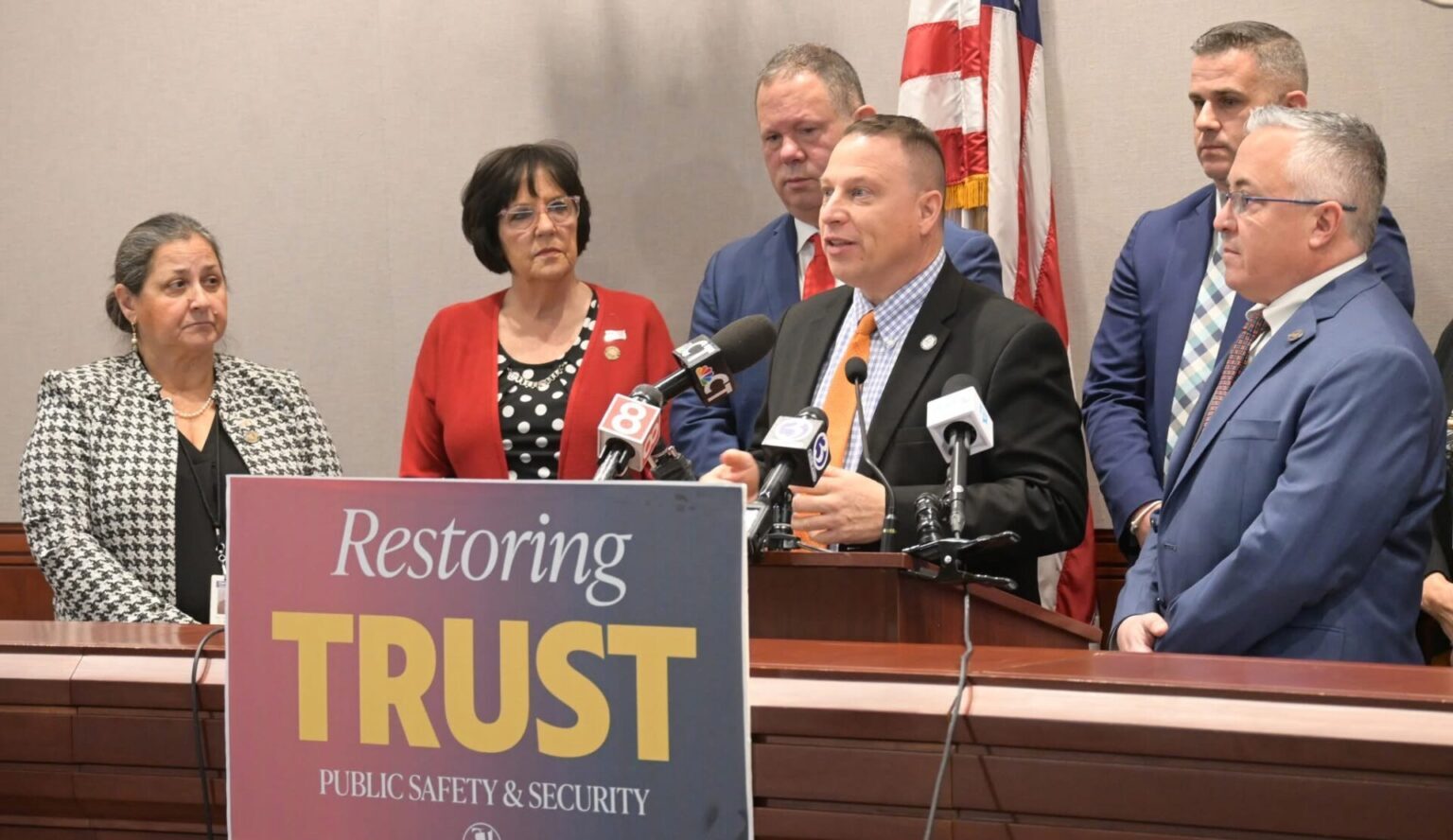
“April Fool’s?” CT Families Aren’t Laughing. Senate Republicans Blast Democrats for Failure to Make CT More Affordable (Watch the press conference here.) Senate Republicans on April Fool’s Day blasted supermajority Democrats for failing to make Connecticut more affordable as Democrats offer legislative proposals to make the state even more unaffordable for working families. “Supermajority Democrats ... Rob Sampson
04/01/2026
By State Sen. Rob Sampson One of the most fundamental rights in a free society is the ability of citizens to speak to their government and participate in decisions that affect their lives. In Connecticut, that right is supposed to exist within the legislative process itself. Bills normally move through committees and public hearings where ... Rob Sampson
03/30/2026
Plainville, CT— State Senator Rob Sampson (R-16) issued the following statement in response to the recent tragedy in Plainville and the growing memorial honoring the victims: “I am deeply saddened by the horrific events that took place in Plainville and the tragic loss of innocent lives. My thoughts and prayers are with the victims’ loved ... Rob Sampson
03/16/2026
Hartford — State Sen. Rob Sampson (R-16) issued the following statement today in response to a press conference held by Sen. Mae Flexer and Rep. Matt Blumenthal regarding election legislation before the Connecticut Government Administration and Elections Committee. “Today’s press conference appears to be another attempt by Connecticut Democrats to distract voters with outlandish claims ... Rob Sampson
03/13/2026
Data-Driven Study Places Sampson #1 Among CT Senate Republicans for Legislative Effectiveness Hartford — State Sen. Rob Sampson (R-16) has been ranked the most effective Republican State Senator in Connecticut according to the latest State Legislative Effectiveness Scores released by the Center for Effective Lawmaking, a research initiative of Vanderbilt University and the University of ... Rob Sampson
As we enter this season of reflection and renewal, I want to take a moment to wish everyone celebrating a very Happy Easter and a meaningful Passover! ... See MoreSee Less
April is Autism Awareness Month and today we recognize Autism Awareness Day!
It’s a time to listen, learn, and uplift those individuals by promoting awareness, empowering families, and encouraging opportunity.
Learn more at Autism Speaks: www.autismspeaks.org
#AutismAwareness #WorldAutismMonth
World Autism Awareness Day
Autism Speaks Advocacy
... See MoreSee Less
My latest column:
‘When Debate Becomes Inconvenient in Hartford’
By State Sen. Rob Sampson
One of the most fundamental rights in a free society is the ability of citizens to speak to their government and participate in decisions that affect their lives.
In Connecticut, that right is supposed to exist within the legislative process itself. Bills normally move through committees and public hearings where citizens testify, legislators debate, and the public can see how their government operates.
That is how representative government is supposed to function.
Unfortunately, that process is increasingly being bypassed.
On February 25, legislative Democrats pushed through a massive omnibus bill using what is known as “emergency certification,” or an “e-cert.” This maneuver allows leadership to skip the entire committee process and bring legislation directly to the House and Senate floors for immediate votes.
No testimony.
No committee debate.
No opportunity for the public to weigh in.
The law requires that the reason for the “emergency” be stated. Curiously, none was provided. Apparently, it was an emergency simply because leadership declared it so.
The bill itself was a grab bag of unrelated policies and millions of dollars in earmarks directing taxpayer money to politically favored organizations. I jokingly called the day “Earmarksgiving.” The joke wrote itself.
But the underlying problem was serious. As I said during debate, this was not emergency government. It was convenience government.
The rules were ignored simply because the majority had the power to do it.
A day or two later, during another debate, the Speaker of the House became frustrated with the time I spent raising concerns about legislation and suggested that if I was not careful, I might lose “what I love so much,” my microphone.
Vigorous debate had become inconvenient.
Then things escalated.
A week or two later, the Legislative Office Building was packed with Connecticut residents who came to Hartford to defend their fundamental freedoms.
Three controversial public hearings had been scheduled simultaneously, proposals involving new vaccine mandates for adults, increased regulation of homeschooling families, and more nonsensical gun control measures.
Each proposal targeted a different group of citizens the majority party seems increasingly comfortable treating with hostility, gun owners, parents who educate their children at home, and anyone who still believes personal medical decisions belong between patients and their doctors.
Hundreds of citizens showed up to participate in the democratic process. Hallways overflowed. Hearing rooms were packed. People waited hours for the chance to testify.
This is exactly what civic engagement is supposed to look like.
But not everyone at the Capitol seemed thrilled to see it.
I testified in opposition to two of the gun control bills being considered that day. During my remarks, The Democrat Judiciary Committee co-chairman became so frustrated by my comments that he suggested the rules be changed to place lawmakers at the end of the speaking list in the future.
Apparently debate had again become inconvenient.
Meanwhile, the public hearing on vaccine legislation stretched late into the night. More than 550 citizens had signed up to testify. After more than fourteen hours of testimony, Democratic leaders voted to shut the hearing down shortly after midnight, cutting off many citizens who were still waiting to speak.
Republicans objected, but the decision stood.
Think about that for a moment.
Citizens drove to Hartford. They waited all day. Some waited into the early hours of the morning. And when their turn finally approached, the hearing was simply shut down.
So Republican legislators did the only responsible thing they could and moved to another room to allow the remaining citizens to testify anyway. It was not an official hearing, but at least those voices were heard.
That should not have been necessary.
Then, only days later, Senate Democrats used their taxpayer-funded digital propaganda publication, The Capitol Dispatch, to suggest that I may have violated ethics rules simply by debating housing legislation while also being a housing provider.
Let’s be serious.
Legislators routinely bring professional experience to the committees they serve on. We have doctors shaping public health policy and attorneys debating judicial matters. A conflict exists only when legislation uniquely benefits a specific individual.
That obviously was not the case here.
But the message behind the attack was unmistakable. Challenge the majority too effectively and they will try to discredit you.
Taken together, these incidents reveal a troubling pattern.
When debate becomes inconvenient, the process is bypassed.
When citizens show up in large numbers, hearings are cut short.
When lawmakers push back, microphones are threatened.
And when that still does not work, personal attacks follow.
That is not how a healthy democracy is supposed to function.
The good news is that more Connecticut residents are paying attention. People are reading the bills. They are showing up at hearings. They are asking tough questions.
Perhaps that growing scrutiny explains the tension we are seeing in Hartford.
But the answer to public pressure should never be silencing debate.
Public hearings, transparency, and open discussion are not inconveniences. They are the foundation of representative government.
If citizens are willing to drive to Hartford, wait for hours, and testify before their government, the least their government can do is listen.
Connecticut residents deserve leaders who welcome debate, not fear it.
And when debate becomes inconvenient for those in power, that is usually a sign it is working.
... See MoreSee Less